


Hi Leader,
Imagine you’re leading a meeting.
A woman shares an idea, gets interrupted mid-sentence, and the conversation moves on without missing a beat. Two minutes later, someone else says essentially the same thing…and suddenly it lands. The room lights up, heads nod, and momentum builds around an idea that was already in the room five minutes ago, attached to a different name.
Nobody pauses. Nobody connects the dots.
I mean ya’ll…someone just got their intellectual property stolen in broad daylight, and the meeting continued like absolutely nothing happened. No police tape. No investigation. Just Gary presenting her idea with full confidence while she sat there trying not to flip the table.
And according to research, it’s likely that you watched the whole thing happen, and you said nothing.
If that’s a situation you’re familiar with witnessing, congratulations. You just taught your entire team exactly whose voice matters in that room…and it wasn’t hers.
The data behind that moment is worth sitting with.
About 60% of men believe they’re strong supporters of women at work. When you ask women? Only about 30% agree.
That’s not a communication problem or a perception issue…that’s a leadership failure hiding in plain sight, playing out in meeting rooms every single day.
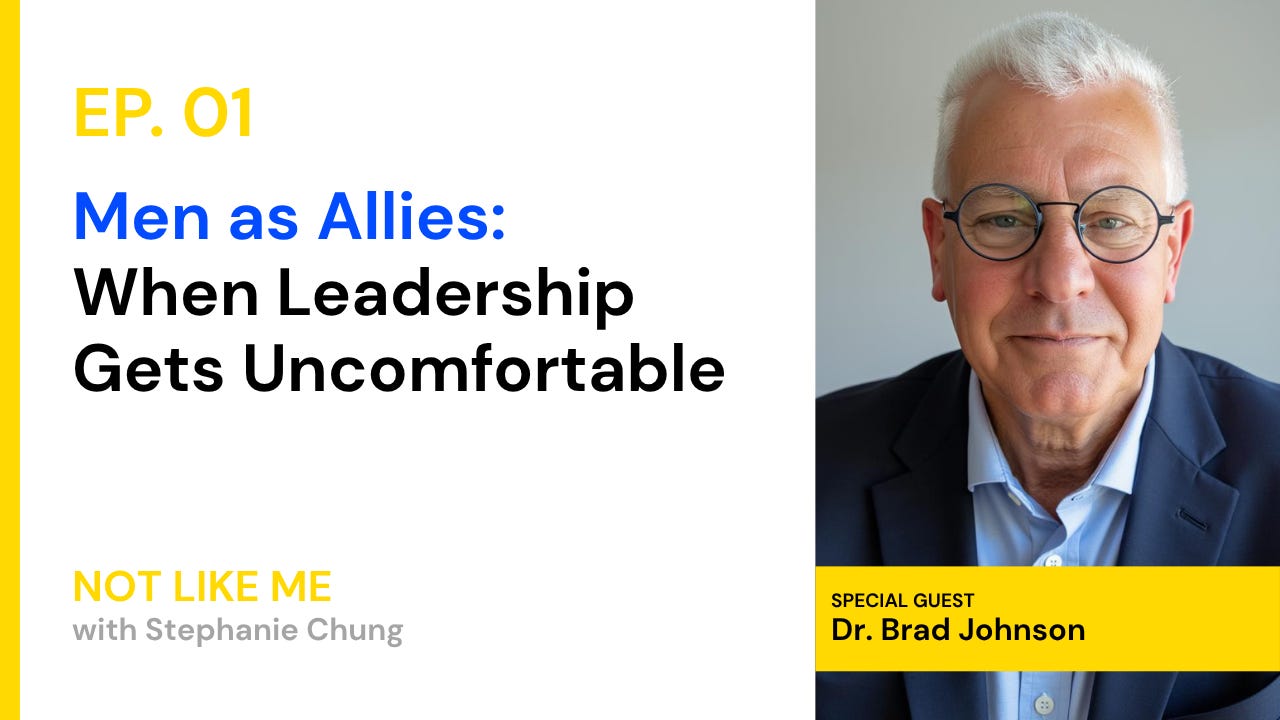
I had a behind-the-scenes conversation with my friend Dr. Brad Johnson, a researcher, author, and one of the most clear-eyed voices I know on what allyship actually looks like in practice versus what leaders think it looks like. Brad has spent years studying this gap, and sitting with him, hearing the data up close, it hit differently than reading it in an article. Because behind every percentage point is a room full of people who stopped speaking up.
That conversation, and honestly dozens like it that most people never get access to, is what finally pushed me to do something my friends, colleagues, and team have been asking me to do for a long time: start a podcast.
I’m already in these rooms. I’m already having these conversations. But that’s exactly the problem, most people aren’t. And what gets said backstage is too important, too useful, and frankly too good to stay there.
So here I am, introducing: Not Like Me

The first episode is my full conversation with Brad, digging into what it actually looks like to close that gap. Not as a label you give yourself at a DEI training and forget by Thursday. But as something you do, in real time, in the moments that are easy to miss and even easier to avoid.
Listen or Watch Episode 1 of Not Like Me here

Here’s the part nobody talks about, because it’s uncomfortable and it doesn’t make leaders look great. It’s not that leaders don’t care. Most of them genuinely do.
The problem is that caring is passive, and leadership is not.
When someone gets talked over in a meeting, your brain isn’t thinking about values or allyship or any of the things you wrote in your LinkedIn bio. It’s running a fast, automatic calculation: Is it safe for me to step in right now?
That’s your amygdala, your brain’s ancient threat-detection system, prioritizing your social comfort over your leadership responsibility. And your amygdala does not care about your leadership philosophy. It did not read your performance review about how inclusive you are. It is simply trying to keep you from being socially awkward at 2pm on a Tuesday.
The result is a half-second pause that turns into a full second, and then someone else is already talking and the moment is gone.
Meanwhile, the person who just got interrupted is running their own calculation. Her brain is asking a quieter but far more damaging question: Do I actually belong in this room?
When that question goes unanswered enough times, behavior changes. They might contribute less, self-edit more, and stop bringing their best thinking to the table. Your team doesn’t decline all at once. It happens one overlooked moment at a time, and you won’t see it in the numbers until it’s already too late.
And before you tune out thinking this is a conversation only about women… it isn’t.
This same dynamic plays out with newer employees sitting across from senior leaders, introverts stuck in high-energy rooms, and underrepresented voices navigating majority groups.
The pattern is remarkably consistent. Some voices get amplified, others get minimized, and the leader’s response…or telling non-response teaches the room what’s acceptable. Every single time.
None of this requires perfection. It requires paying attention and being willing to act on what you see, even when it’s slightly uncomfortable. That discomfort is just your brain running its default protection program. Strong leaders learn to override it with a better question: What does leadership require right now?
That’s the shift. And it’s a skill, not a personality trait, which means you build it by practicing it, not by intending to.
This week, pick one meeting. Pay attention to who gets interrupted, overlooked, or talked past. Then step in. Not perfectly, but intentionally. That’s how Ally Leadership becomes consistent, and that’s how you earn the title, not because you decided it for yourself, but because the people you lead watched you prove it.
Want practical language ready before that meeting happens? The V.O.I.C.E. Cheat Sheet gives you conversation tools for the exact moments we’ve been talking about, including how to handle interruptions, set boundaries, and communicate your impact with confidence.
Download the V.O.I.C.E. Cheat Sheet here
Dr. Brad Johnson and I go much deeper on all of this in Episode 1 of Not Like Me. If you want to sharpen how you lead across difference, this conversation will challenge you in the best way.
Listen to Episode 1 of Not Like Me here
And if you want to go even further, Brad’s book The Fair Share breaks down how work gets distributed inside teams, what often goes unseen, and what it actually looks like to build a more equitable, high-performing environment. It’s practical, it’s clear, and it will give you more language for how to lead in these moments.
What you just read is the framework. What comes next is what I don’t say on stages. The specific follow-up moves that make allyship actually stick after the moment passes, how to handle the pushback that sometimes follows when you do step in, and the one thing most well-intentioned leaders do that quietly unravels everything they’ve built. I’m also sharing the questions I ask myself after hard moments in the room, because staying honest with yourself is half the work.
Listen to this episode with a 7-day free trial
Subscribe to Your Ally in Leadership to listen to this post and get 7 days of free access to the full post archives.


